CASE FILE 01
The Night Museum
20 rooms
Your child solves mysteries and learns maths, English, verbal and non-verbal reasoning along the way. You get a clear view of what is secure, what is slipping, and why marks are lost.
Free to start for invited UK families. For ages 8 to 10 (Years 4 to 6).
What we teach
All 116 skills, in the open. Each one has lessons, practice and a place on the parent skill map. Pick a subject to see what is inside.
37 SKILLS
From times tables to algebra: number, fractions, geometry, data, ratio and problem solving.
Number
Calculation
Number properties
Fractions, decimals and percentages
Patterns and problem solving
Measures, time and money
Geometry
Data and probability
Ratio, algebra and rates
31 SKILLS
Comprehension, vocabulary, grammar, spelling and cloze. Writing is taught through study notes and multiple-choice questions; your child’s own writing is not marked.
Comprehension
Vocabulary
Grammar and punctuation
Spelling and word building
Cloze
Writing
28 SKILLS
Word puzzles, word meaning, codes, number series and logic. Often unfamiliar at first, so each puzzle type is built up step by step.
Word puzzles
Word meaning
Codes and letter patterns
Number reasoning
Logic and sentences
14 SKILLS
Patterns, rotations, nets and cubes, with figures drawn for each question.
Pattern reasoning
Spatial reasoning
6 SKILLS
Reading the question, multiple-choice strategy, checking, pacing and the clock: the habits that stop marks leaking away.
Most 11+ tests do not publish a full topic list, so we cannot promise that any one test is covered. The School planner shows what each school’s test is known to use. More about subjects and quality checks
What your child gets
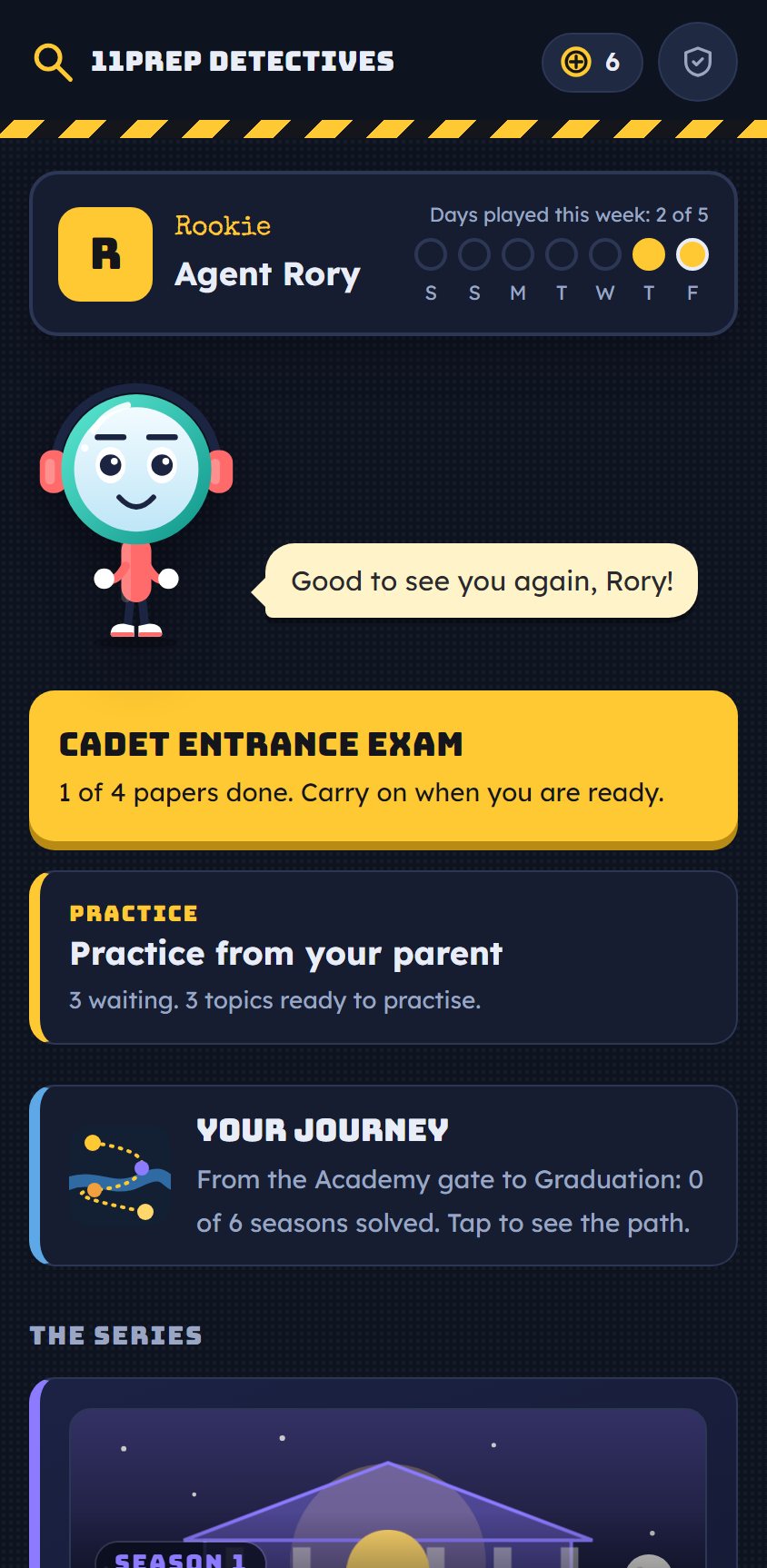
Short sessions, clear lessons and kind feedback, so practice feels like play.
The Cadet Entrance Exam is four short papers. No marks are shown to your child and there is no pass or fail. It sets up their personal plan.
Every room has lessons and three short rounds of questions that find the next clue.
Zoom explains every answer and never judges. A slip gets “so close, have another look”.
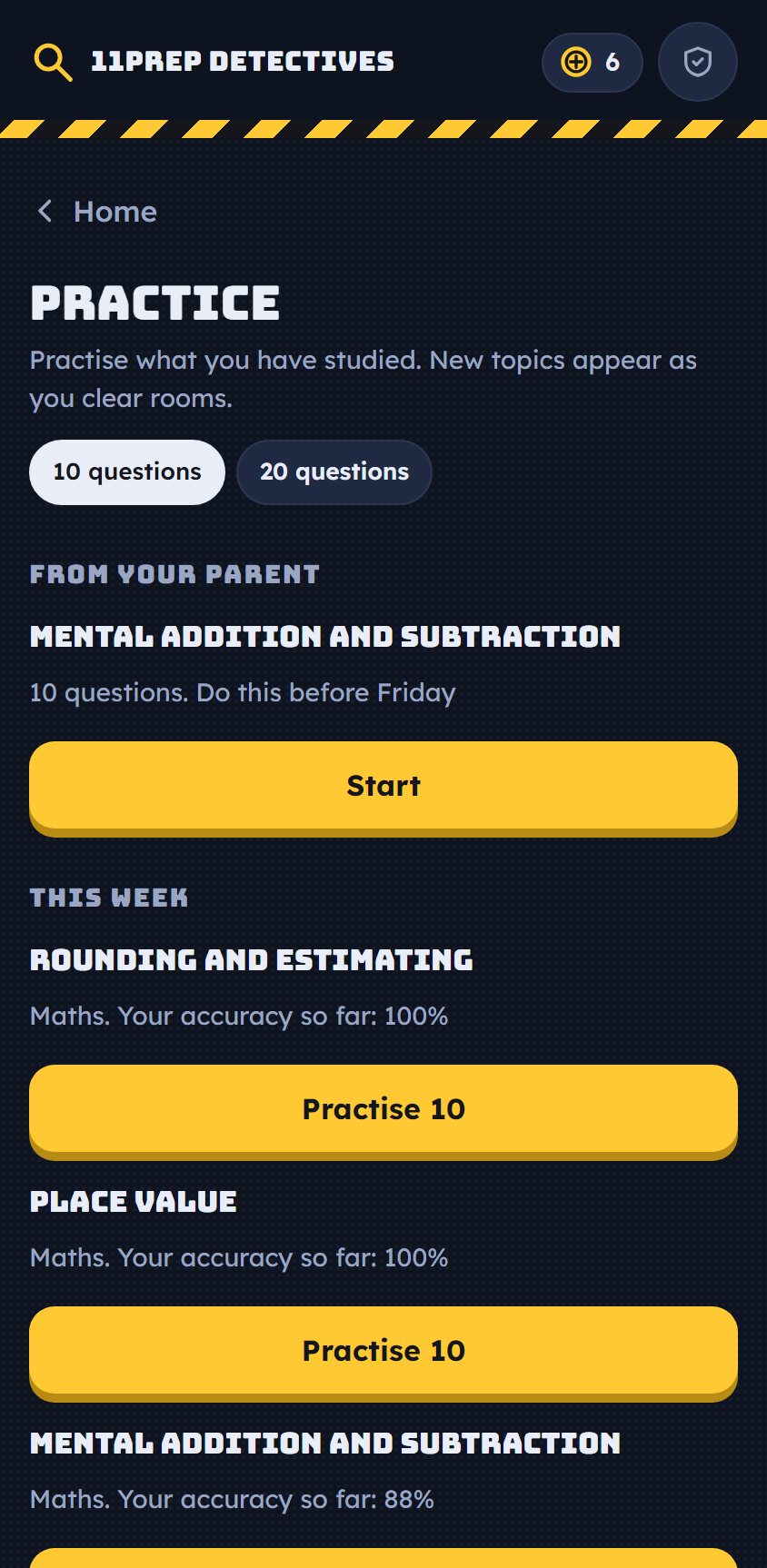
Practice is built from the topics they have studied: this week’s topics, or a mix by subject. A parent can set a practice on any skill.
Reading the question, checking answers and pacing the clock: the skills that stop careless marks being lost.
Six seasons of mysteries, a suspect board, arcade tokens and Ada’s secret sentence to uncover.
Try one
A taste of the real thing, one from each subject. Pick an answer and Zoom will explain it.
A school buys 240 new books. 15% of them are damaged. How many books are not damaged?
Zoom explains: 10% of 240 is 24 and 5% is 12, so 15% is 36 damaged books. Take that away: 240 − 36 = 204. (36 answers a different question, how many are damaged: a tempting trap!)
Choose the word that best completes the sentence: “The detective was ______ that the thief had left by the window.”
Zoom explains: The gap follows “was”, so it needs an adjective to describe the detective. “Certain” is the adjective. “Certainly” is an adverb, “certainty” is a noun and “certify” is a verb.
What comes next in the series? 2, 3, 5, 8, 12, ?
Zoom explains: Look at the gaps between the numbers: +1, +2, +3, +4. The gaps grow by one each time, so the next gap is +5. 12 + 5 = 17.
Which square comes next in the series?
Zoom explains: Two things change together. The circle moves one corner clockwise each time, and its colour swaps between dark and light. After a dark circle in the bottom right comes a light circle in the bottom left.
Sample questions written for this page. In the app, questions get harder as your child does well.
STEP 1
Four short entrance papers show where your child is strong and where to begin. No marks are shown to them, and no pass or fail.
STEP 2
Rooms, clues and suspects across all four subjects. Short lessons, three rounds, and an explanation for every answer.
STEP 3
Skills growing, why marks are lost, speed against accuracy. A Progress Check later shows how far they have come.
For parents
See what is secure, what is slipping and why marks are lost. A range, not a promise. More for parents
Where the current pace could lead. The range narrows as more answers arrive.
Most skills are right but slow: speed rounds will help.
Slips and rushing are habits, and habits can change.
Every chart here uses made-up data for a made-up child. We show a range, we do not promise a pass, and we never rank your child against others.
The parent portal
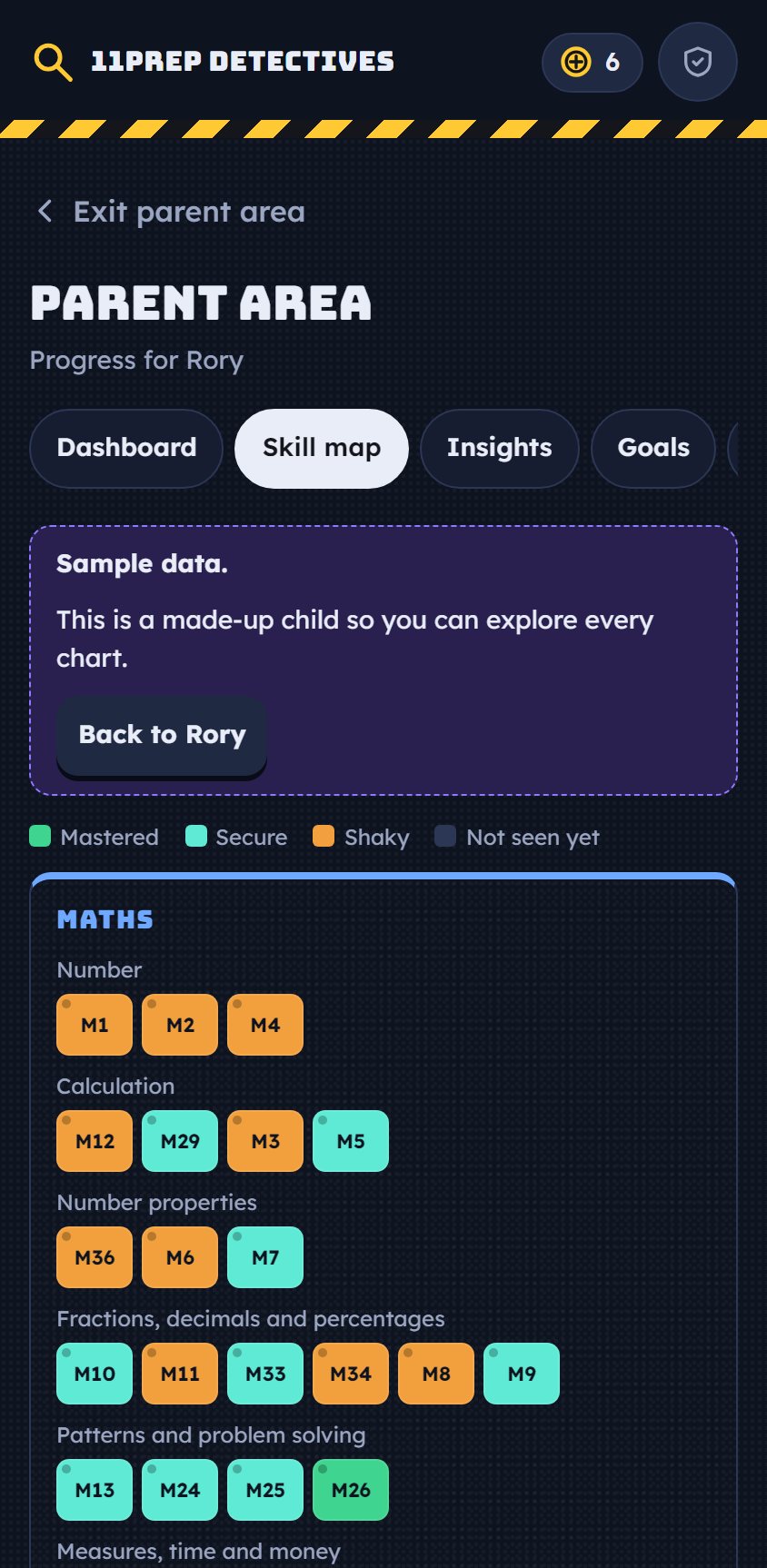
Every skill shown as not seen, shaky, secure or mastered, laid out like an evidence board.
A range with an estimate to your test date. It never says “will pass”.
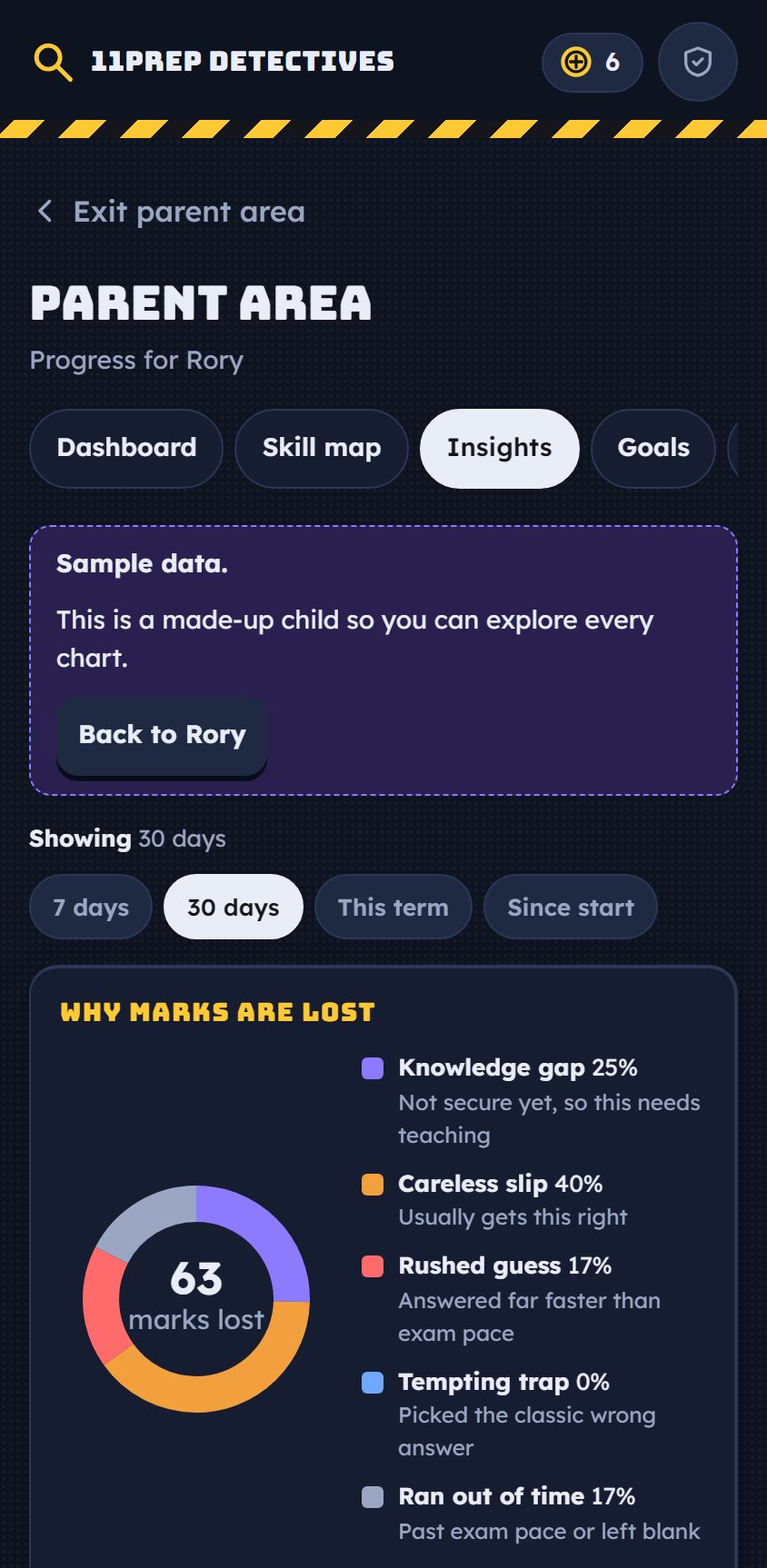
Knowledge gap, careless slip, rushed guess, tempting trap or running out of time.
See how your child’s pace compares with a typical exam pace. The pace figures are indicative.
Skills that are starting to fade are flagged, so you know what to revisit.
Pick a skill from the map and set a practice for your child, with a note. It shows in their Practice list.
A weekly summary, a printable term report and a read-only link for a tutor.
Inside the portal
Straight from the app, using its sample-data mode so you can see every chart filled in.
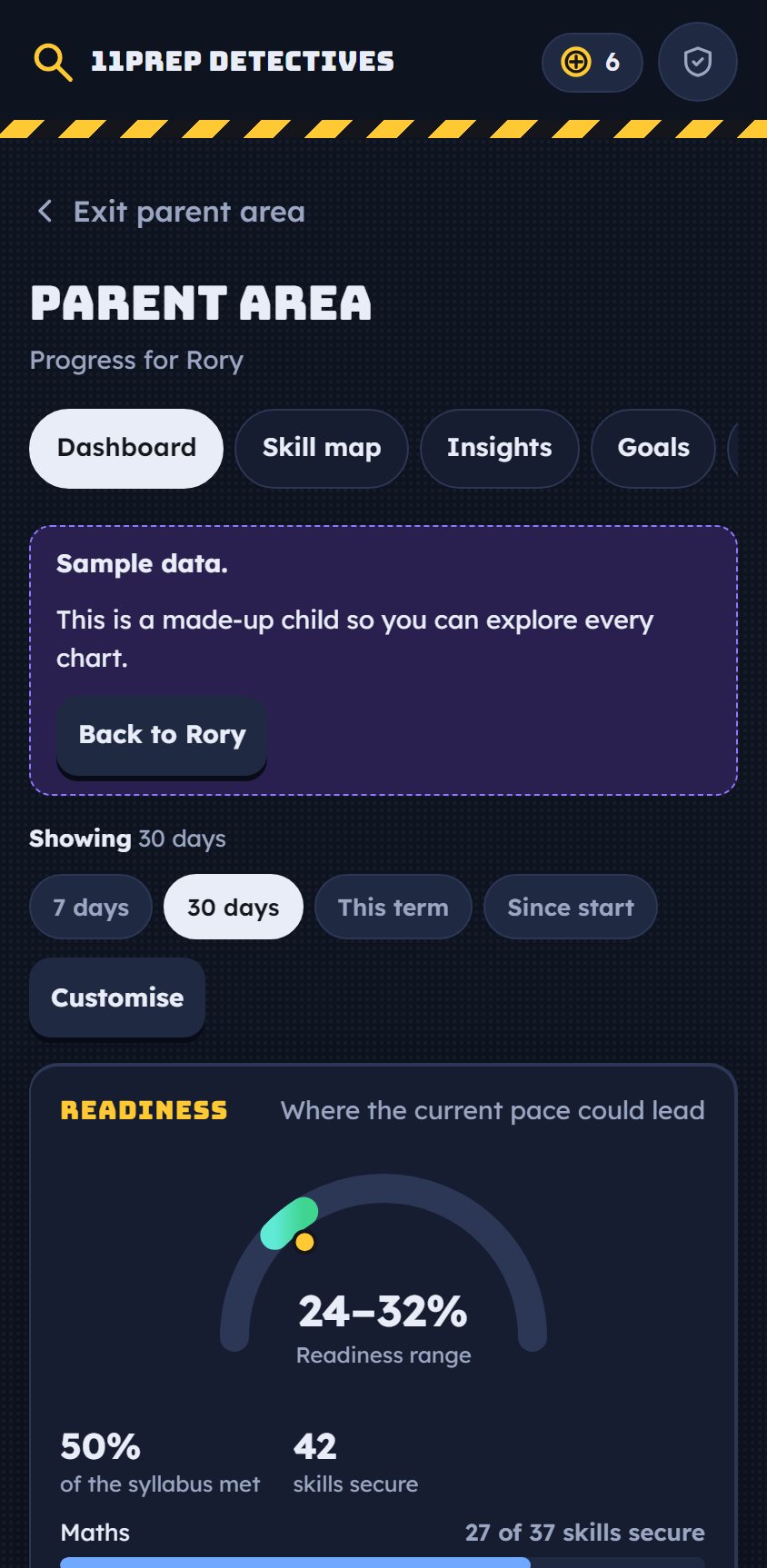
Where the current pace could lead, which narrows as more answers arrive. Skills secure by subject, plus a 60-second summary of the week.
Sample data for a made-up child.
Each skill is a tile, marked mastered, secure, shaky or not seen yet, and grouped by topic, so you can see exactly where to help.
Sample data for a made-up child.
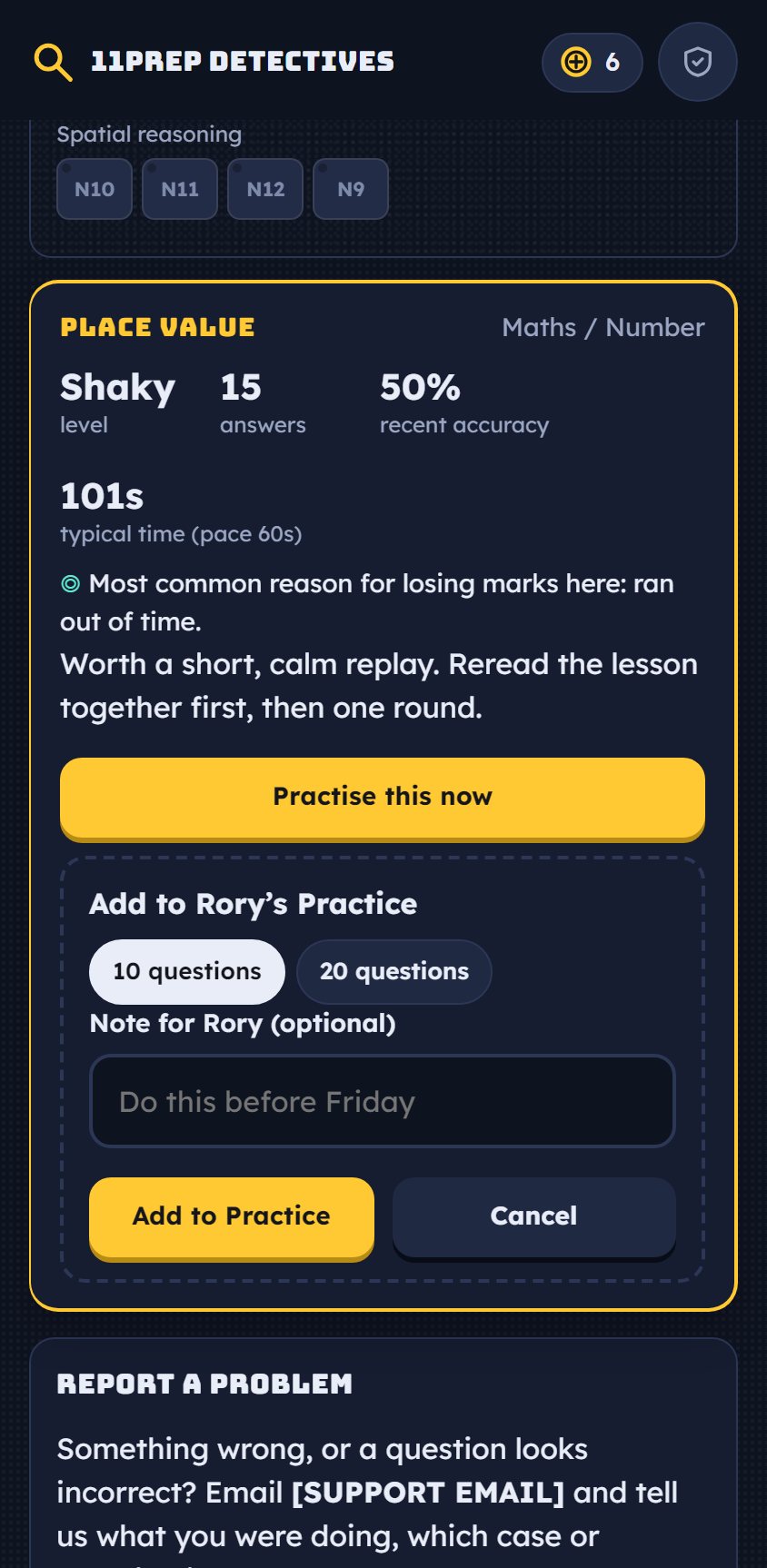
From the skill map, Chapters or Weak spots, set 10 or 20 questions on a skill, with a note. It appears in your child’s Practice list, and you see it marked done with the score.
Sample data for a made-up child.
Knowledge gap, careless slip, rushed guess, tempting trap or ran out of time, plus speed against accuracy compared with a typical exam pace.
Sample data for a made-up child.
Six seasons
116 rooms across six seasons, and Season 1 is free. Drag, scroll or use the arrow keys.
CASE FILE 01
20 rooms
CASE FILE 02
21 rooms
CASE FILE 03
21 rooms
CASE FILE 04
21 rooms
CASE FILE 05
18 rooms
CASE FILE 06
15 rooms
Planning for a particular school?
Shortlist UK schools, see what each test is known to use, and get a day-by-day study plan with a calendar download. It saves in your browser and sends nothing to us.
Who made it
11Prep Detectives was built by a parent, and tested by 8-year-olds. It is a small independent project, made to be the kind of 11+ practice a child will actually sit down and play, and a parent can actually understand.
Free to start for invited UK families. Tell us where to send it.